
I Don't Like Ads
- 6 minutes readI Don’t Like Ads …Which is probably why I ended up designing ads
Early in my career, I wanted to work on what most designers want to work on. Consumer apps. Highly engaging products. Back when social platforms like Instagram were still considered exciting problems to solve.
It did not take long to realize two things.
First, many designers want those roles, especially early in their careers. Competition is high, and opportunities to influence direction meaningfully are limited.
Second, while these products always leave room for improvement, they already serve their audiences well. The problems tend to be incremental. Optimizations rather than structural shifts. The likelihood of spending years on micro-improvements felt high.
That pushed me to look elsewhere.
I started paying attention to less glamorous spaces, assuming that unresolved problems would be larger, messier, and harder to ignore. Areas where a change in approach would matter more than polish. That search led me to AdTech.
I have never enjoyed ads in their conventional digital form. Most people do not.
They interrupt reading, fragment attention, and assume that being seen is the same as being considered. Over time, users adapt. Entire regions of interfaces are filtered out subconsciously. Interaction becomes accidental rather than intentional.
This outcome reflects how digital advertising has been built for years.
At scale, the numbers align with that reality. Display ads commonly operate below one percent click-through rates. Even when clicks happen, only a small fraction converts. Most interactions are brief, shallow, and disconnected from genuine interest.
This is the environment Buzzvil has been operating in.
Not to marginally optimize it. Competing head-on with the largest platforms would have been unrealistic anyway. The work focused on examining its structure more closely.
⸻
Treating Ads as Interaction Systems
Most ads are built as endpoints. One action, one expectation, one outcome.
Our work gradually shifted toward building ads as interaction systems. Experiences with entry points, progression, feedback, and resolution. This required thinking in ways more common to product or game design than media inventory.
A key aspect of this shift is how reward is used.
Reward functions as a pacing mechanism. It sustains momentum, signals progress, and gives users a rational reason to continue as interactions become more involved. It also establishes boundaries. Users understand what effort is expected and what value is exchanged.
When users understand what they are stepping into, engagement changes shape. Interaction becomes deliberate. Completion becomes common. Drop-offs become interpretable and therefore fixable.
Across Buzzvil’s interactive formats, engagement behaves differently from conventional advertising. Click-through rates land in ranges that would be considered statistical outliers elsewhere, and completion rates often exceed eighty or ninety percent in well-designed flows. This emerges from interaction structures that maintain attention coherently over time.
In this model, reward carries users further through the funnel without distorting it. New users are paced through interaction until they reach the advertiser’s defined Aha moment, or exit earlier with clear signals as to why.
A few concrete cases help make this more tangible.
⸻
Game UA: Activation After Installation

Traditional game user acquisition focuses heavily on installs, then disengages at the point where most users churn. The ad experience stops at the store page. Onboarding, comprehension, and early motivation are left entirely to the game.
Our approach treats installation as the beginning of the experience.
Multi-step rewarded missions extend the ad flow into gameplay, where user intent is still fragile, and core mechanics are not yet internalized.
Each mission surfaces a meaningful slice of the game. Players are guided through actions or systems that correlate with long-term engagement. Progress is incentivized, feedback is immediate, and momentum is maintained through clear goals.
The objective is explicit. Drive users toward the advertiser-defined Aha moment, the event that reliably correlates with retention, habit formation, or social attachment.
User acquisition shifts closer to activation. Rewarded missions function as a controlled onboarding layer that publishers can tune against retention outcomes rather than installs alone.
⸻
Multi-Mission Brand Campaigns: Sequencing Understanding
From Awareness to Consideration and Conversion
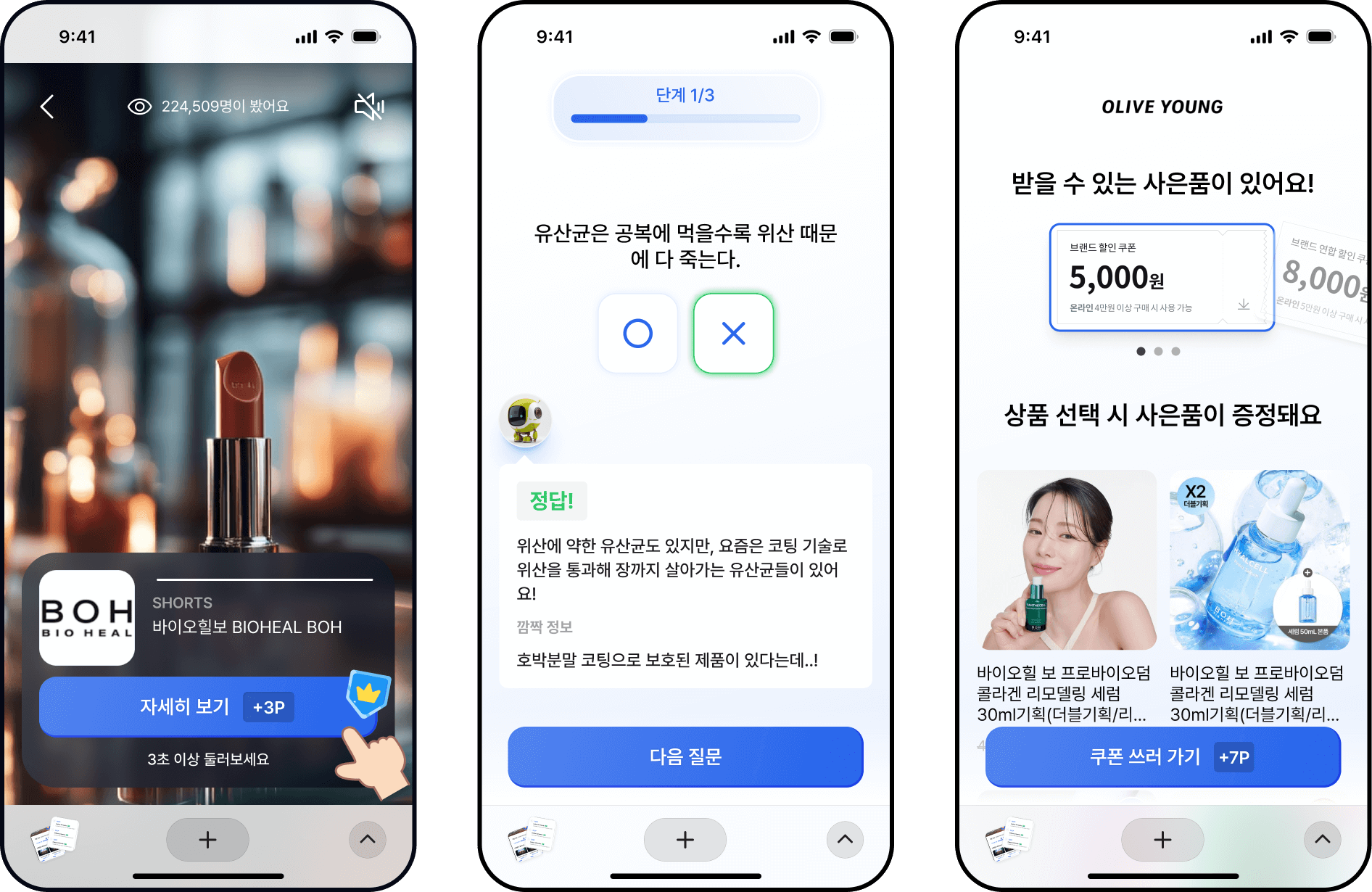
Brand campaigns often compress too much meaning into a single moment. Awareness, interest, and conversion are expected to happen at once.
Multi-mission formats distribute interaction over time. Users move through a sequence of short, self-contained touchpoints. Watching, answering, choosing, exploring. Context accumulates gradually.
Design work here centers on sequencing. Each interaction prepares the next.
This sequencing becomes practical because of where these campaigns live. Buzzvil operates across a large network of Korean apps, which allows the same user to be reached again in different contexts, without forcing repetition into a single session.
An initial touchpoint introduces a brand and establishes recognition. Users who complete it carry that context forward. When they encounter a follow-up interaction later, the experience can acknowledge prior exposure instead of starting from zero.
Subsequent touchpoints shift toward exploration. Browsing a product range, configuring options, or interacting with brand-specific mechanics designed for the host app. The interaction adapts to a user who is already familiar, rather than assuming first contact.
Later touchpoints guide interested users toward purchase, often supported by collaborative rewards or discounts aligned with the brand. Because prior steps established understanding, these incentives reduce friction rather than compensate for uncertainty.
Completion rates remain high across stages because interactions align with user state and timing. Brands receive clearer signals at each step, and users experience continuity rather than isolated impressions. The campaign functions as a connected system, distributed across time and inventory, rather than a single overloaded moment.
⸻
Where This Leaves Us
The design work at Buzzvil sits between product design, interaction design, and behavioral design. It operates under tight constraints and continuous measurement, and evolves through quick iteration made possible by our capacity to reach out to millions of users in a short period of time.
At its core, the work focuses on shaping decision-making moments. Each interaction is designed to make expectations, effort, and value legible through use rather than instruction. When these elements are clear, user behavior becomes easier to reason about.
That clarity carries through the funnel. Engagement reflects intent. Completion reflects understanding. Drop-offs highlight friction points that can be addressed through design.
Over time, this approach produces systems that remain stable as complexity increases. They support different advertiser goals, adapt across formats, and stay comprehensible to users. Rewards pace progress. Missions structure movement. Interfaces prioritize continuity.
This is the space where our design practice continues to develop. Advertising is treated as an interactive system, shaped with the same discipline and accountability as any other product experience.