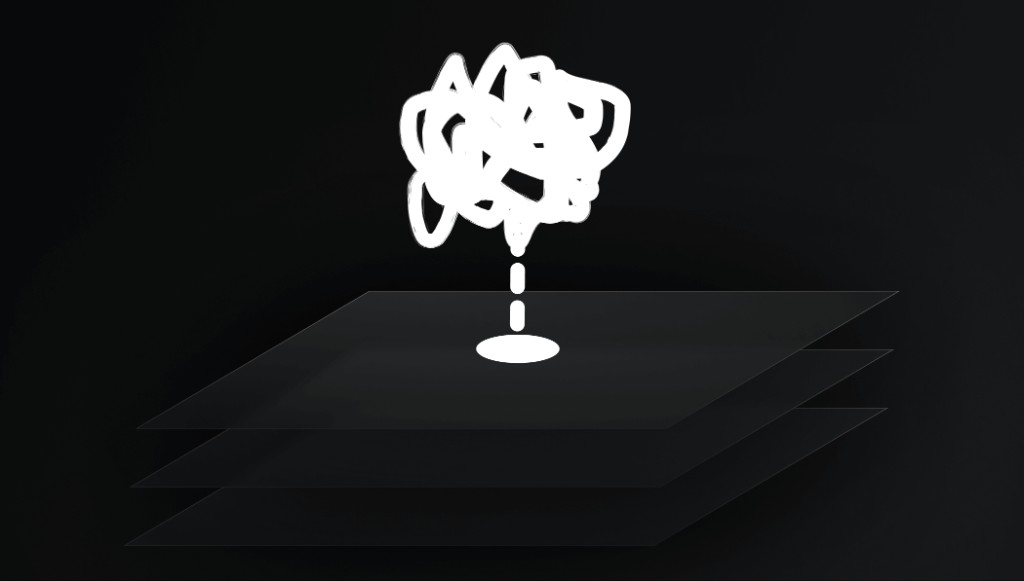
Designing Above the Interface
It is becoming slightly impolite to say this out loud, but designers are no longer valuable because they can make things.
We are entering a period where the act of making is no longer scarce. Interfaces, flows, and entire product systems can be produced at a velocity that outpaces our ability to critique them. The results look finished. Occasionally, they actually are. But they are rarely thoughtful.
A designer’s value is shifting from execution to discernment. They are valuable because they can decide which things deserve to exist and explain why clearly enough that a machine can build them.
Grading the homework
In his talks on learning in the age of AI, Po-Shen Loh makes an observation that fits design perfectly. For a long time, we were taught how to do the homework. Now, the vital skill is knowing how to grade it.
When an AI can generate a hundred reasonable solutions before the kettle has boiled, volume is no longer a challenge. The designer’s role shifts from maker to judge.
This judgment is rarely loud. It shows up as the ability to say that something is technically correct but still fundamentally wrong for the product.
Working with theory, not prompts
There is a massive difference between asking an AI to “design a cool admin page” and giving it a working theory of the world.
The first produces something presentable. The second produces something intentional. Designers add value by articulating the story before the work begins. They define the people who rely on the service, the pressures they are under, and the specific compromises the product is willing to make.
When intent is vague, AI fills the gaps with generic patterns and polite assumptions. When intent is precise, the machine becomes a high-leverage collaborator.
The superpower of empathy
Good judgment rests on empathy. Po-Shen Loh describes the ability to “simulate the world” through someone else’s eyes as a superpower.
AI can analyze behavior and summarize trends. It cannot feel the irritation of a confusing label or the quiet relief of being understood. Designers who remain useful will be the ones who still notice these moments and treat them as meaningful data rather than incidental noise.
This requires leaving the safety of tools and dashboards to engage with users as they are, not as an abstraction.
Efficiency is a sandpaper
As products become more efficient, they also become more alike. This is what optimization does. It sands off the human edges.
Designers add value by noticing what disappears in that process. Delight lives in the margins, in the decisions made with care rather than urgency. In a world full of products that work, people remember the ones that feel considered.
The convergence of roles
As AI blurs the boundaries of execution, people often ask who survives: the Product Designer or the Product Manager?
The most honest answer is probably neither.
We are seeing a gradual merging of responsibilities around a shared center of gravity: intent. The job is to decide what should be built, for whom, and why. The goal is to articulate that decision clearly enough that humans and machines can act on it.
The people who remain valuable will be the ones who can frame problems, navigate uncertainty, and maintain judgment when the tools become overwhelming. Whether they started as designers or PMs will eventually be irrelevant.
Who decides?
By 2026, the question is no longer who can produce the most output. Machines have settled that.
The real question is who decides what the machine makes, and on whose behalf. The answer will not be a job title. It will be a way of thinking.
As machines become very good at making things, value shifts to those who can decide what is worth making at all.
Part of The AI-Native Design Playbook, a full guide for designers, PMs, engineers, and leaders moving from mockup-and-handoff to AI-native design.
Related
- Next: When the Interface Assembles Itself
- The same convergence, as a hiring rubric: The Job Description Is Wrong
- Where it started: From Paper to Code
Related
Po-Shen Loh on learning in the age of AI — the talk that inspired the "grading the homework" idea in this article.
Related
Designers Open the PRs Now
6 months. 432 pull requests. One design team. What got better, and what it cost us.
A Design System for an Agent
The consumer of our design system changed from designers to agents. What that breaks, and how craft survives when an agent does the composing: the judgment moves into the recipe, it doesn't disappear.