When Creation Becomes Real-Time
What happens when the distance between imagining a product and experiencing it approaches zero?
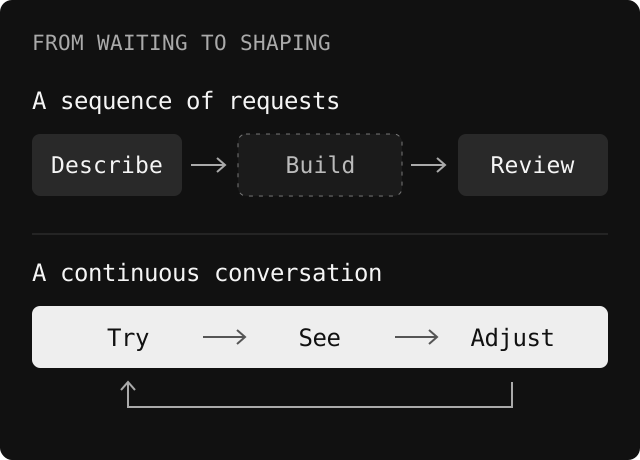
I recently started using GPT-6 Astra alongside Claude, and the speed of execution caught me off guard.
As a designer, I often want to iterate quickly on details. Now I can ask for a change and see it live on my local server a few seconds later. The result arrives while I’m still thinking about what to try next.
That changes the rhythm of the work. If models continue improving at this pace, I expect designers and product teams to be shaping products in real time before long. Creating could become a continuous conversation with a working product, with less distance between an intention and the experience of it.
From iteration to interaction
The shift isn’t simply about faster generation.
Imagine adjusting a character’s behavior while watching it move. Changing the structure of an application without leaving its interface. Describing an atmosphere and seeing its colors, motion, and spatial composition evolve immediately.
The traditional separation between design, prototype, and production begins to dissolve.
Rather than building a representation of an idea before implementing it, we could work directly on the functioning system.
The product becomes both the medium and the result.
This ambition predates generative AI. In Learnable Programming, Bret Victor describes an environment where creators develop ideas by reacting to a visible work in progress. Faster generation could bring more of product creation into that kind of feedback loop.
What becomes possible?
1. Continuous creative direction
Instead of writing specifications, creators could shape experiences through conversation, gestures, and direct manipulation. An intelligent system translates intention into structure, behavior, and implementation in real time.
2. Exploration at an unprecedented scale
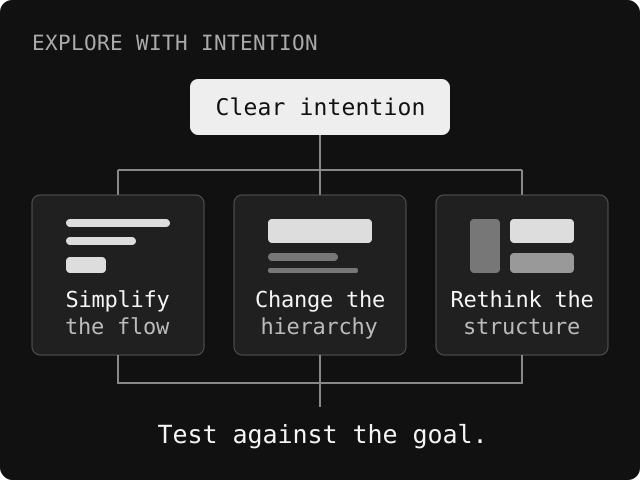
When generating alternatives becomes inexpensive, creators can explore dozens of directions rather than committing early to a handful. Ideas become easier to test, compare, combine, and discard.
3. Products that evolve during use
Designers could observe an interaction, modify the experience, and test the alternative almost immediately. The distance between observing a problem and evaluating a solution becomes dramatically shorter.
4. Small teams creating complex systems
As implementation, testing, and maintenance become increasingly automated, individuals and small teams could build products that previously required much larger organizations.
5. Design systems that understand intention
Rather than merely defining components and visual tokens, design systems could encode principles: how a product should behave, communicate, adapt, and feel. AI could interpret these principles across new features and interactions.
Intention before execution
The capacity to build immediately can also produce a pile of waste. With an unclear intention, we could generate more features, more overlapping tools, and more polished answers to problems we have barely understood.
The cost of generating a first version may fall, but the cost of keeping it does not disappear. Someone still has to understand it, integrate it, maintain it, and decide when to remove it. Even an abandoned prototype consumes attention. A collection of impressive outputs can quietly become a product nobody needs.
A clear intention names who has a problem, what should improve for them, and how we will recognize that improvement.
Google’s People + AI Guidebook makes a similar starting point explicit: identify a real user need and define success before deciding where AI belongs.
“Build a dashboard” describes an artifact. “Help the support team spot unresolved customer issues before they are forgotten” gives us a problem to investigate and an outcome to test. The answer might be a dashboard, a reminder, or a change to an existing workflow. Starting with the outcome leaves those possibilities open.
This does not require a perfect brief before making anything. Building can help us discover what the problem actually is. But each experiment needs a question, and some evidence that would lead us to keep, change, or discard it. The intention can evolve as we learn; it gives that learning a direction.
Some of the time saved in execution should go back into listening, observing, and defining the problem. Otherwise, we risk becoming extraordinarily efficient at accumulating things that never needed to exist.
A different creative process
If almost anything can be created instantly, how do we decide what deserves to exist?
Today, implementation costs naturally limit exploration. We prioritize because time and resources are finite. As those constraints diminish, the challenge shifts from production toward judgment.
Taste, coherence, critical thinking, and the ability to recognize meaningful ideas may become more valuable than the ability to execute them.
There is also something worth preserving in the process itself. The resistance of materials, the time spent experimenting, and the unexpected discoveries made during implementation often shape the final idea.
Removing friction could accelerate creativity. But removing every form of friction might also make it shallower.
In interviews with 22 product team members, Jie Li and colleagues found reports of faster iteration alongside concerns about shallow exploration and over-reliance on AI. These are accounts of working practice, not a speed benchmark, but the tension is familiar: producing more does not necessarily mean thinking further.
Toward 2030
My expectation is that between 2027 and 2030, continuous AI-assisted creation will become increasingly practical, particularly for visual interfaces, interaction design, and web-based products.
Complex architecture, security, and production reliability will still require deliberate engineering and verification. Real-time creation won’t mean that every change is instantly safe or complete.
But for a growing range of creative decisions, the distinction between thinking, making, and experiencing may become remarkably thin.
Perhaps the next revolution in creative software won’t be a better tool for making things. It will be an environment where making and thinking happen together.
And when the distance between imagination and implementation approaches zero, we may discover that the most important creative ability was never execution alone.
It was knowing what to make, why it matters, and when to stop.
References
- Bret Victor, Learnable Programming (2012). Creating through immediate feedback and visible work in progress.
- Google PAIR, User Needs + Defining Success, People + AI Guidebook. Starting with the problem and the outcome that matters to people.
- Jie Li and colleagues, Vibe Coding in Product Teams: Reconfiguring AI-Assisted Workflows, Prototyping, and Collaboration (2026). An interview study of 22 product team members, including the benefits and limitations of AI-assisted creation.